


 November
11,
2026

Help people build skills and recognize their leadership potential before promotion.
Leadership development often begins when someone becomes a manager. Yet the transition starts earlier, as people consider whether leadership is something they want, something they could be good at, and something they can see themselves doing.
Recently, my team delivered a pilot of an Emerging Leader Academy for a rapidly growing provider of workplace water and beverage solutions. The academy brought together aspiring leaders, newly appointed managers, and people already taking on leadership responsibilities without the title.
Our client intentionally targeted employees with leadership potential – including people who might not yet see themselves in that role. The goal: strengthen both their leadership capabilities and their self-image as emerging leaders.
The Five Key Elements
1. Know the person behind the potential.
The company’s VP of HR and Senior Director of Learning Development and People Enablement worked with us to develop an emerging leader persona covering the learner’s profile, motivations, possible resistance, key messages to convey, and preferred ways of learning. It guided our content and program design.
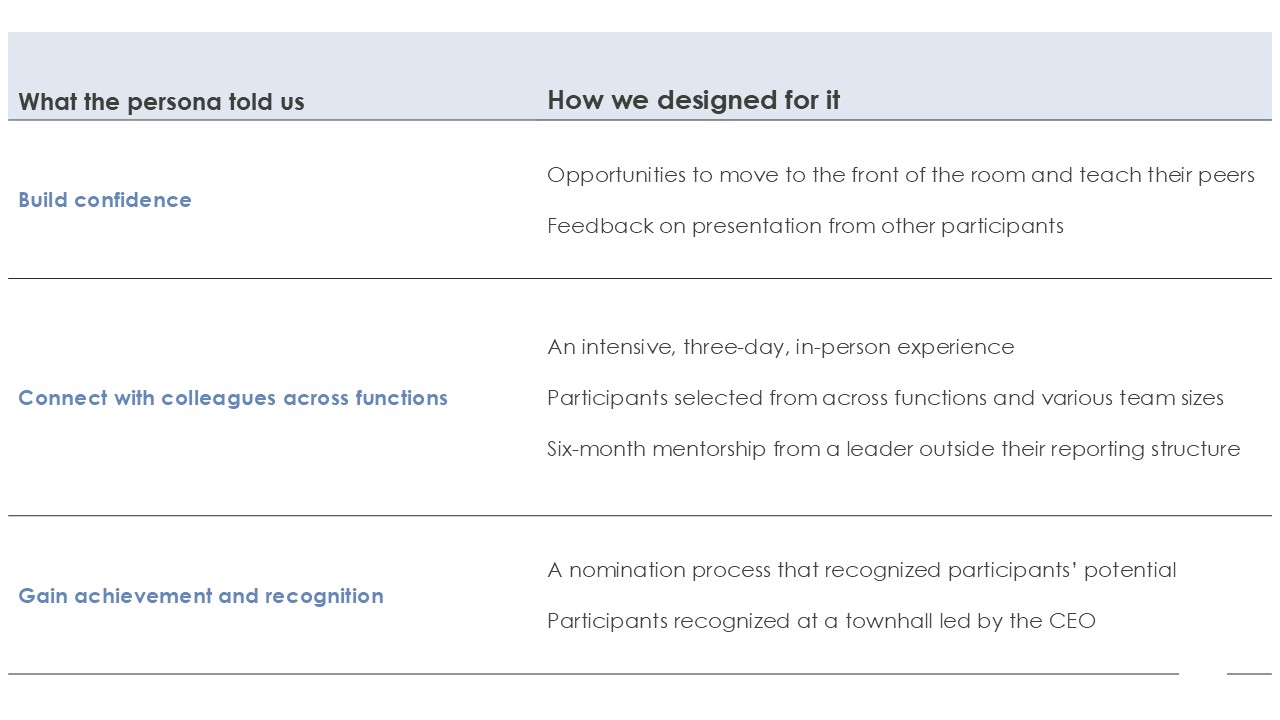
The value was in connecting what we understood about learners to specific choices about their experience.
2. Engage the leaders who will develop the next ones.
Senior leader helped identify topics, then prioritize them. Three days plus pre-work could not cover everything, so we mapped topics against potential business impact and the complexity of developing and teaching them. We considered how often participants would use each skill, its importance in daily work, and the risks of getting it wrong.
These conversations helped leaders develop their own language and stories about the program. We brought them back to review the workshop blueprint and suggest updates, then involved them in nominations and participant notifications.
Micah Green, Emerson Associate Client Director, was the project lead who guided ELA design, development, and facilitation. He emphasizes the importance of leader engagement: “When we assigned pre-work and held the in-person workshop, we did so with confidence, because we had engaged all affected levels of the organization – from executive leaders to potential ELA participants. In an age of AI, there’s absolutely no substitute or shortcut for these face-to-face discovery conversations.”
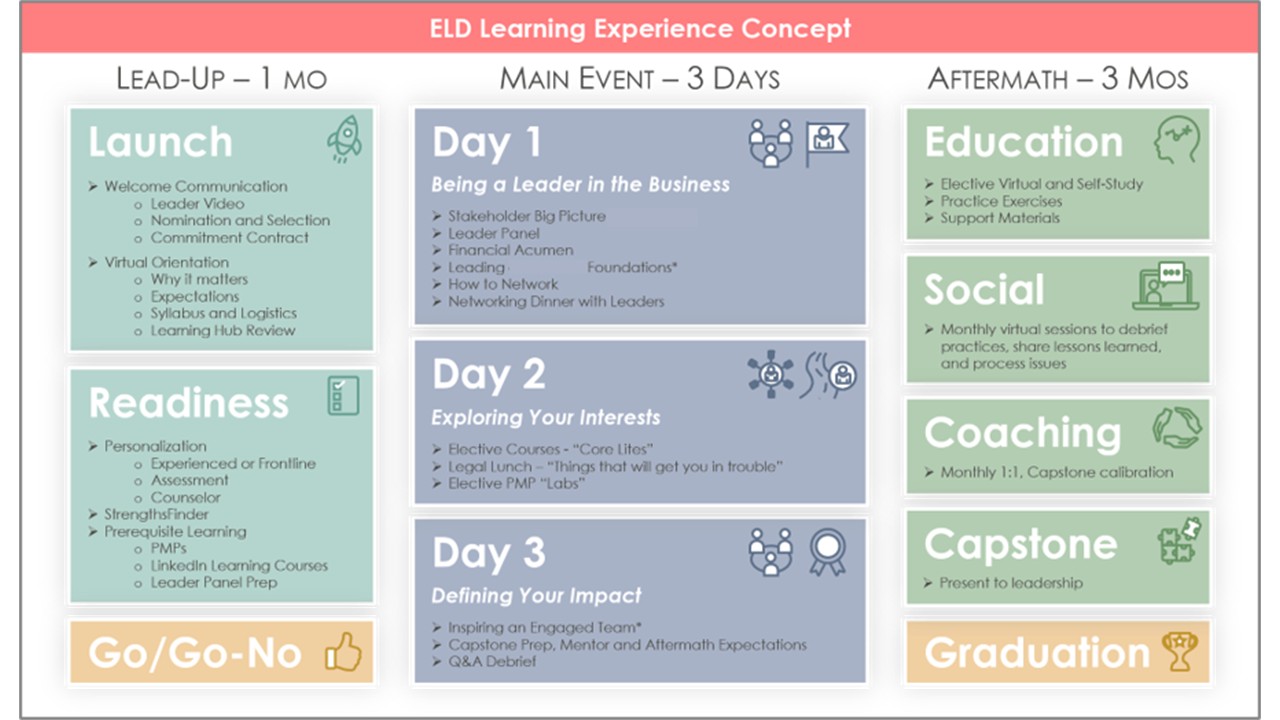
The participants’ received a toolkit with questions for before the workshop, afterward, and during the capstone. They met with participants to discuss pre-work and scheduled a follow-up to hear about the experience. Their involvement gave learners support beyond the training room.
3. Ownership starts before the classroom.
Every pre-work topic followed a simple structure: Learn, Think, Do. We curated content using the company’s existing LinkedIn Learning license, then connected it to reflection and workplace practice.
For giving and receiving feedback, participants were asked to:
- Learn: Complete a self-guided course on giving and receiving feedback.
- Think: Reflect on how the learning applied to situations typical of their organization.
- Do: Give or request feedback, then document the experience.
Participants arrived to the session with experiences to discuss, leaving classroom time for practice, scenarios, and conversation. Taking responsibility for their development was itself preparation for leadership.
4. Give people a chance to see themselves lead.
Participants also taught their peers. For example, in the module Communicating with Impact, each team’s teach-back had four parts:
- The Big Idea: Explain the one thing the audience should remember.
- The Tools: Teach the Audience and Message Planner and What, Why, Next.
- The Demonstration: Show a before-and-after example from the message clinic.
- The Application: Share a habit to use, a mistake to avoid, and a first change to make.
Our facilitators reported that teaching back raised the accountability in the room. Every participant took a presentation role. They were creative and engaging, and they took the responsibility seriously. They had an opportunity to experience leading others and helping their peers learn.
5. Keep the development going when the workshop ends.
Participants are now beginning a 90-day capstone, working in groups on a real business problem identified by the Executive Leadership Team. The capstone project must:
- Require leadership behavior
- Have clear stakeholders
- Have evidence of potential impact
Participants begin with a project charter, which lays out the problem, stakeholders, actions, timeline, risks, support requirements, and success measures. At the end, they present their work to that team for evaluation.
Alongside the capstone, each participant will receive six months of mentoring from a leader outside their reporting chain. This phase creates opportunities to apply their skills, explain their recommendations, and seek guidance as they develop.
Micah says, “This is one of the parts of the program I’m most excited about. The last thing we wanted was a ‘one-and-done’ event: participants come in for a few days, have some great thoughts and plans, then go back to work — never processing or implementing what they learned. The mentorship component is the key to translating a really great learning program into behavior change. And I can attest to the fact that ELA mentors will get just as much out of this as the ELA participants; everyone benefits.”
Recognizing What Is Possible
The pilot’s early feedback is encouraging. All 14 evaluation respondents agreed or strongly agreed that they felt better equipped to lead and that the Emerging Leader Academy was a worthwhile investment.
But the comment I keep coming back to is this:
“Previously, I would have never thought of myself as a leader. And now that I have these resources and tools in my back pocket, I know that I can step up to the plate.”
That captures why this gap – between how others see a person’s leadership potential and how they see themselves – was such a priority for our client. People may need someone to recognize their potential and give them opportunities to experience it before they can picture themselves as leaders. That work can begin well before a promotion.