

Transformation.
-
Maintain Your Organization’s Work Style During Big Change
Transformation is stressful enough. Don’t make things harder by losing what works. Focus on these three areas to stay true to your organization’s work style.Work style is how things get done. It’s the day-to-day manifestation of your organization’s culture — the unspoken way we work and deliver projects. It’s framed by purpose and guided by values.
During times of intense change, it’s important to be aware of your organization’s work style, and to honor it. Transformation projects are stressful enough to knock even the strongest of us off-course. The best way to help your organization is to stay true to what works for you.
There are three key areas of focus.
Communication. How much communication does your organization need? What kinds of communication work for you? The channels might be formal, informal or a combination. Every organization is different. For example, if your teams are highly focused on running an operation, or they are spread out geographically, you might need dedicated, in-person events like town halls to reach them. Who are credible messengers to spread the word, — managers or respected peers? It’s critical to know what it takes to get employees to focus their attention.
Consensus Requirements. Does your organization run on consensus? The answer drives the speed of decision-making. Whose opinion matters? If all the key people need to buy in, build in time to gain that consensus. Identify which stakeholders have to bless each decision, follow a process, and make sure the teams know their voices have been heard. Depending on the topic, you might need less consensus. Take advantage of that – push work to the lowest-level teams that can make the decision.
Relationships vs. Structure. To what extent does work get done through deep relationships vs. systems and process? If relationships are important, plan for that. Create a framework that fosters relationships. For example, create robust onboarding, recognition methods, and celebration rituals. Relationship-based cultures will resist too much structure if it’s visible. If your teams are more systems-oriented, lean on those processes. But be careful – it’s easy to ignore a well-oiled machine. Make sure you review processes — at least annually — to ensure they help employees to their best work. Identify and close any gaps.
Clarifying your organization’s best working styles helps leadership strike the right balance between empowerment and accountability. And it makes any big transformation so much easier.
So, what’s your style?
-
Virtual Onboarding
What we know about brain science can give your new employees a great transition to your virtual team.Make it familiar, controlled, and successful.
How do you onboard employees virtually? How do you get them engaged and performing through a screen? Most of us are acquainted with the basic mechanics of virtual onboarding:
- Welcome the new hire with something tangible like a plant, gift basket, or company-branded gear.
- Keep each virtual onboarding session short and interactive.
- Use strong presenters.
- Expand the elapsed time for onboarding from one or two days to as many as 30 days.
- Issue surveys to gauge engagement and solicit feedback for improvement.
But we think good virtual onboarding has to go deeper. When you’re onboarding employees, you’re asking them to change their behaviors—do this, in this way, to this standard. You are also hoping to reinforce their positive feelings about the organization, so they feel welcome and they are part of something great.
Science tells us that if we want behavior change to work, we should make it feel familiar, controlled, and successful.
Familiar
Our brains see new things as dangerous, so change – like a new job – can create feelings of resistance. But familiarity, as mentioned in other posts, feels “safe.” You can activate those feelings of safety in your onboarding program.
Determine what makes most new employees feel great about the employer—for example, the culture, the brand, the physical environment, the great people, and the proper supports and resources. Highlight those familiar “feel good” elements in your welcome video and guest speakers. The more you remind them of what they already know and like, the better.
Use video tools that are familiar to most participants. We all know Zoom. Many of us will not be familiar with GoToMeeting or TeamViewer. Make the login to the virtual onboarding easy. First impressions matter.
Include live speakers or filmed testimonials from people who look and sound more like your new employees. If your new hires are in their 20’s and mainly Black or Brown women, they won’t connect as well to, let’s say, middle-aged White men.
Repeat certain onboarding activities throughout the program; for example, use weekly check-ins with their boss and a peer coach. Over time, these events will start to feel familiar.
Controlled
Humans love to feel in control. Giving new hires the feeling of control reduces anxiety and frees their brains for learning and executive functioning. You can do this by building in structure, predictability, and choice.
Develop an onboarding timeline and share it repeatedly when meeting with the new hires. For example, if a group of new hires connects every week, show them the timeline with a “you are here” marker.
Provide new hires with the right tools: laptop, easy connectivity, digital onboarding tools, and job aids. How about a new hire portal or MS Team Site to house all this information? Include FAQs and key contact information they can have at their fingertips.
Give them some choices up front: Surface or MacAir? Flextime vs. standard business hours?
Build some flexibility into their onboarding tasks so they can exert some personal control over their schedules and not feel like their new employer is programming every minute of the day.
Successful
Winning releases dopamine, the brain’s feel-good chemical. And sharing success promotes oxytocin, the connection hormone. You can build success into your onboarding program.
Small and simple successes might be things like signing up for health benefits or getting their parking pass activated. Highlight each successful step. Consider gamification to track these successes, with a nominal reward or recognition at the end.
Handling some of their new job activities, with support of their new manager and peers, will also make them feel successful. Keep things small and simple in the beginning, so you are sure they will complete them correctly. (Failing at one of these tasks will produce the opposite effect!) Have managers give new employees coaching and feedback along the way. You could even build completion and sign-off into your gamification approach.
New hires feel more successful when they feel they are becoming part of the team. Interpersonal and social successes count too! Can’t gather at the local sports bar? How about a virtual happy hour or beer bash? Schedule some virtual team lunches or coffee breaks—the company could pay to have the meal or coffee delivered to the new hire.
The last word…
Create your company’s onboarding experience to promote feelings of familiarity. New hires will feel they’re more in control of their transition when you include choice, structure, and predictability. And they’ll feel more successful if you provoke the feel-good chemicals in their brains through small wins, feedback and rewards, and orchestrated virtual events that make them feel like they belong. It’s a different world now, but people are still the same. What we know about brain science can give your new employees a great transition to your team.
-
Dear Coronavirus
While many have suffered from a devastating health crisis, COVID-19 also opened our eyes to the need for real transformation.Dear Coronavirus,
As strange as this seems, I have a love/hate relationship with you. While so many around the world have suffered in the last few months from a devastating health crisis you caused, you also did something good. You exposed our flaws and opened our eyes to the need for real transformation.
At first, we were at a loss. You forced us to stay at home and we didn’t know how to handle that. Work from home? Be at home? With the entire family? 24/7? Home-school our kids? In a world where everything has become social, offices have moved to blue-sky models, collaboration is king, companies have moved to face-to-face and personalization as the best ways to communicate…here we are, suddenly isolated.
What’s old was new again. Families started to eat dinner together, watch movies together, play board games, and do puzzles. As we began to social distance, institutions on the verge of going under, like drive in movie theaters, began to surge.
More importantly, we saw positivity and creativity. Communities supported each other with food and supplies. Businesses got creative about how to work and how to deliver to customers.
The whole world began to think differently, work differently, relate differently, and behave differently.
Then, the death of George Floyd happened. Suddenly, people came together in a different way—in a protective and resilient way. And while you did not cause that, you set the stage for it. You stoked a feeling that we must stand up and fight to survive. That if we can survive you, we can survive a lot. And that, when the racism reared its ugly head— again—it would not be ignored.
This time, we had already rallied around a cause. You reminded us that, standing together, we are more powerful. And that’s when something beautiful happens. We behave differently. We say “No more. Not on my watch.”
So while you continue to linger in our lives like a toxic cloud (and, in a cruel irony, attack people of color more savagely than the rest), you have revealed our power. You helped us realize that, while we can’t control you, we CAN control some things.
Dr. Martin Luther King wrote,
“Like a boil that can never be cured so long as it is covered up but must be opened with all its ugliness to the natural medicines of air and light, injustice must be exposed, with all the tension its exposure creates, to the light of human conscience and the air of national opinion before it can be cured.”
You poured alcohol on the open wounds that need to heal. You’ve brought light to things that need to be more visible and voices to those who didn’t realize they could be so loud.
You showed us what it means to slow the day down, appreciate what we have, love each other, stand up for what we believe in, and maybe even restore our faith in humankind. You reminded me of the power of real change— transformational change. I still hate you. But how amazing it is to be part of that.
-
Scale Your Workforce in Tough Times
At Emerson, we think of talent management holistically -- it helps achieve the business outcomes you want. But how can you streamline the process? Download our latest whitepaper to learn how. -
How to Handle Resistance to Change
How do you confront the hecklers disrupting your change initiative? You don’t.You’ve probably watched a heckler interrupt a public speaker. Maybe you’ve watched – on video or in person – as a performer or politician has to deal with mocking or derisive comments, shouted from the crowd. Maybe the speaker answers back, or security escorts the heckler from the venue.
Change initiatives can have hecklers too. They usually don’t shout down a speaker; they use other ways to criticize and disrupt.
It’s to be expected. People are resistant to change. Hecklers might say negative things about your project or predict it will fail. They might even try to sabotage project activities or influence others to join in their negative campaign. You might secretly wish you had security to escort those hecklers from the building! But that’s not going to happen.
So how do you confront hecklers? You don’t.
Here’s what you do. Instead of seeking out and addressing every critic of your project, focus your energy where it counts. Figure out who has the ability to influence the success of the project. Are some of those influencers mildly resistant or mildly supportive of the change? Those people are your sweet spot. They matter, because they can affect the project. And they’re not so strongly against your project that they’re beyond persuasion. Your sweet spot is that group of hecklers that you could actually turn into advocates, with a little effort.
But how do you bring them over from the dark side? Communication and involvement are your tools.
Communication. Ask: What do they care about? What are the benefits of the change to them? What negative consequences will they feel if the project fails? What do they need to hear to make this change seem like a good idea?
Involvement. Ask: How can we help them own the change? Where can we leverage their expertise? What has resonated with them in the past to spur them to action? Based on that, what how can they participate? Focus groups? Governance? Serving as subject matter experts?
So don’t confront all of your hecklers. Instead, focus on those in your sweet spot. Continue to communicate, engage, train, and support them as you execute your change management plan. As the project bandwagon grows, the fans will drown out the hecklers.
-
Your Diversity Training Isn’t Working; Here Are 5 Ways To Fix It
In a divisive world, your company can be a powerful unifier. Here's how.You have to hand to it Starbucks. It knows how to focus attention on fixing an issue. The act of shutting down operations for a half-day of training, whether it be for a turnaround or to address discrimination, says it is committed to a change and voting with its profitability. The execs clearly know that substantial short-term financial loss is better than long-term erosion of the brand.
But make no mistake, while its commitment to training is legend, its employee behavior change strategy rests on the symbolic act. The reason? Most diversity training doesn’t work. Here’s why:
We don’t think we’re the problem. Let me ask you directly. Are you racist? Of course not! Neither am I. We can’t see our own biases. They are unconscious. It’s a weird form of the Dunning-Kruger effect, where we assume our ability and our empathy are better than they are. The very lens we use to view the world is hard to see.
It feels punitive. Remember the one kid who acted up in school and got the whole class punished? Diversity training feels the same. It’s a bit like mandatory traffic school without an aspiring comic. So we enter the classroom closed to learning.
We don’t like training. Okay, there are nerds out there who do. But most people prefer to spend their time in other ways. We tend to favor information that solves a problem when a problem arises. And we know that diversity training, like sexual harassment training, can be a cynical exercise to prevent lawsuits rather than a solution to the essential issue.
It fosters the problem. Sometimes well-meaning programs can be divisive. Affinity groups can be alienating. Poor facilitation can create barriers rather than bridges. Focusing on the negative can be counter-productive. In fact, researchers have found that some training actually reinforces bias.
It reinforces bias?
Unfortunately, it can. In 2001, Lori Robb and Dennis Doverspike asked 90 undergraduate men to take J.B. Pryor’s “Likelihood to Harass” scale before taking an hour of a popular off-the-shelf video training. The men who originally tested as most likely to harass tested with a more negative attitude toward women after training.
What can make a difference?
Putting diversity training in an overall system. In 2016, Katrina Berzukova, Chester Spell and Karen Jehn analyzed over 260 diversity studies to determine the impact training might have. They found that if you want behavior change, not just an intellectual exercise, you need to embed training into the company’s ecosystem. Mentoring groups, social networks, and integration into a broader curriculum demonstrate the organization is committed to an inclusive environment. And that reinforces inclusiveness in your culture.
Mandatory medicine. Berzukova and her colleagues also found that required training is more effective than voluntary. This speaks to the fact that we don’t know we’re biased and might be blind to how we behave. It took court action to integrate schools, and legislative action to allow women to own property and vote. These decisions were controversial at the time but now we have generations of people who can’t imagine the world any other way. We’ve normalized to a higher standard.
If you want a wonderful eye-opener to your own unconscious bias, check out Fons Trompenaars’ work on something we all share: seven common dilemmas. These problems are universally uncomfortable, and our response to them is shaped by our culture.
Ongoing training. One standalone course creates the impression that diversity training is a compliance issue and that, once the class is complete, a legal requirement has been addressed. According the research, periodic training conducted over time reinforces the company’s commitment to its values, and signals that those in authority believe this is what is right.
Physical changes to the work environment. Historically, orchestras were dominantly male. This was because the director personally hired the musicians. This began to change in the 1950’s when orchestras began to involve members in the selection process. But what revolutionized the gender balance in today’s orchestras was blind auditions – having the musician play behind a screen so those evaluating them would have to judge the music alone.
According to Claudia Goldin & Cecilia Rouse, “…the transition to blind auditions from 1970 to the 1990s can explain 30 percent of the increase in the proportion female among new hires and possibly 25 percent of the increase in the percentage female in the orchestras.”
Measures. Data can indicate whether the overall system is what you intend. Take a clear-eyed look at your demographics, complaints, compensation, job applications. These can tell you who your environment attracts and what gets rewarded.
We belong to families, communities, interest groups, and companies. In a divisive world, our company can be a powerful unifier. Accomplishing this takes focused thought and design that reaches beyond the classroom. It’s easy to think that such steps won’t work. But they already have. After all, now we can use a Starbucks restroom without buying a venti triple no-foam latte.
-
A Performance Dip Is Not Inevitable
After a big change, does performance have to suffer? No. Here’s how to help.Everyone knows when change occurs in an organization – when people stop working the old way and start using the new way — there will be a performance dip. In my early days as a consultant, I even taught clients about the typical “J” curve or the “Valley of Despair,” as it was called. We had that conversation as a project started, so the client would know what to expect: a temporary loss, then improvement, then a new stability.
But, is that true? Do companies have to experience a downturn before realizing the benefits of the change? Stated another way, can they afford a drop in performance? Maybe they could in the business world of yesterday, when the pace of change was slower, and the change cycles were longer and less frequent. But today’s reality is one of constant change. To compete companies must be nimble; they don’t have time for a trip through The Valley of Despair.
If your company can’t afford the dip, and you agree that it’s not inevitable, how do you avoid it? You must help your teams strengthen as they climb. Imagine an experienced mountain climber. Each time he tackles a new mountain, he gets stronger and more skillful. In fact, he might become faster and better at climbing as he goes. In between trips, he stabilizes and carefully plans his next ascent. He is moving upward, and only upward – getting only better by building on previous experiences.
Your organization needs that “perform, plan, scale” mindset. Most change comes in stages or waves, and as you plan for the next change, help your team strengthen their performance. In other words, use each change to get better at change. Your tools are high expectations, clear communication, and thoughtful planning and execution.
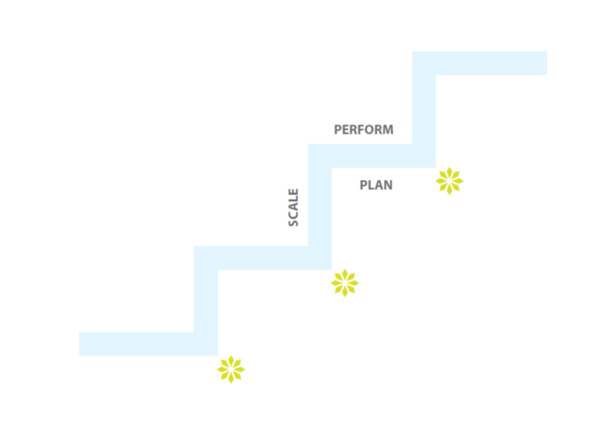
Another tool at your disposal is momentum. Successful change has an expiration date – it’s essential to achieve momentum – early wins or positive impacts on the business — within 90 days. Engineering successes demonstrates legitimacy to the wider organization. If you don’t get that – if you miss the 90-day window — the early energy and commitment can taper off. Keep the “Do it in 90!” rule central to your plans.
Looking back on my earlier years as a consultant, teaching clients to expect a performance dip, I realize I was taking the easy way out. The drop in performance does happen, but it’s also an excuse, used when the change doesn’t show benefits immediately. Don’t get me wrong, change is not easy, and you won’t always get it right the first time, but if you actively manage the change and expectations – yours and those of the organization – you can keep moving upward.
- Managing change is about getting to benefits as soon as possible.
- The organization can get stronger and better at change during the change and while planning the next ascent.
- Momentum has an expiration date. You have 90 days to make a positive impact and demonstrate that the change is legitimate. If we miss the window, we’ve lost the upward energy. Do it in 90!
-
The Right Way to Handle Layoffs
These lessons learned will help you find the best possible outcome in a difficult situation.Thoughtful leaders find layoffs among the most stressful events they manage. Warren Heffelfinger, CEO of Ingenio, has a compelling story.
Hire the best.
In 1999, Warren and his college roommate Dave Riordan started a telecom business.
“It was a crazy time. Telecom was particularly hot; if you had a pulse and could dial a phone you could get private equity backing. The private equity guys wanted us to raise $500 million and hire 1,200 people over a 12-month period. Dave had five years of management consulting experience and I had never hired a human being in my life. So, we went back and said, ‘Listen guys, we’re flattered but you’re nuts. We need to hire a CEO.’”
“The single most important thing that we did in that business was, we hired a boss — the world’s most wonderful role model you could imagine. I would say that I learned 80% of my leadership skills from being joined at the hip with Tony DiStefano for six-and-a-half years.”
But then the market crashed. “We were in the epicenter of the dotcom meltdown. And raising $500 million? We couldn’t raise five cents after April of that year. We faced a gigantic round of layoffs in 2000. And that’s where Tony was the master.”
Err on the side of transparency.
“I had a view that great leaders are paternalistic — they sheild their company from bad news. It’s your job to do that because the company can’t handle bad news.”
“Tony helped me understand that it’s exactly the opposite. We didn’t get funding, our credit line was at risk, we had looming layoffs; all this bad stuff was happening. My gut was to lock Dave and Tony in a room and figure this out. Tony said, ‘No, tell them.’”
“So, we were incredibly open with our team about what was exactly going to happen. In September we said, ‘Listen, one of three things is going to happen: We’re going to find an investor, someone will buy us at the last minute, or we’re going to have to fire everyone. Those are the outcomes. We understand if you don’t want to stick around, but if you do, double-down and work your tail off. That will help us get to the best outcome.’”
“There was an initial shocked reaction. But then everyone was like, ‘Alright, let’s get back to work. We’ve got to work harder.’ It was a great lesson. When given a choice between sharing and not sharing, the answer is almost always: share.”
Tailor your communication.
According to Warren, “A significant percentage of the company sees a problem exists. A smaller subset sees the problem and will figure out what the right solution is. The smallest subset sees the problem, can find the right solution and how to communicate it. Communication is the hardest part. It’s not your knee-jerk reaction. It’s understanding all constituencies and how they are going to be impacted.”
“There are two important constituencies in a layoff: the people you are letting go and the people who are staying. The people who are staying are going take great lessons about how you communicate and how you handle the situation. What you hope for is, they say, ‘This sucks but at least if it ever happens to me, it looks like I’ll be treated pretty well…with respect, like a human being.’ That’s super important communication.”
Fire before Christmas.
“There were some very counter-intuitive parts of our layoffs. For example, we were facing layoffs around mid-December. My reaction was, ‘How can you fire people before Christmas?’”
“But Tony’s answer was, ‘You must absolutely fire before Christmas. Right before Christmas, people are going to Christmas shop and rack up credit card bills because they think they have a job. If you give them the bad news ahead of time, you let them avoid that mistake.’”
“’And, if we lay them off December 15th, they get a month of notice and greater severance. If you wait until January 1st, they only get two weeks.’”
The team followed Tony’s advice. What surprised them most was that people understood. Not only did they save the company, but Warren received thank you notes from people who were laid off.Message based on the strategy, not the person.
Large layoffs are painful, but even the decision to fire just one person can be wildly stressful.
“There was one caustic executive who had a big personality. He was very smart, but manipulative. I was up at 3 a.m., nauseous, not sleeping, for close to a year because I knew he was plotting against me every day. And I knew that every time he walked into my office, something manipulative was happening. He brought benefits to the business, but the psychic cost of having to deal with him every day was extraordinary.”
“I learned that when you decide to let a toxic person go, you’re already six months later than you probably should be. But there’s nothing more liberating than the day you make that decision.”
“Still, you need to create a win-win. The conversation I wanted to have was, ‘You are a pain and caused me not to sleep, and you’re a miserable human being.’”
“But I parked my ego. I said, ‘Listen, I’ve made a hard decision. I’m eliminating your position. You played a significant role as we were transitioning. Now I believe our resources are better spent in other ways. There’s just not a fulltime job here.’”
“I said, ‘I’m open to handling the communication. I’ll handle it if you don’t want to but I’m open to other considerations.’ He thought about it and came back the next day with an elaborate spin on how he wanted to retire and spend time with his kids.”
“We had a three-week transition plan. I let him stand up at the all-hands meeting and drop the news himself. We had a going away party. There was no blow-back whatsoever.”
“Often, once you’ve made the decision a person is not a good fit, you radically overthink the impact of that person leaving on the rest of the organization. That’s my number one lesson to leaders and managers: when you know it, you’re already too late.”
Find your best possible outcome.
The fun of leading a business is accomplishing meaningful work with people we love. The worst part is when the business is struggling and we must make tough decisions. Warren, Tony and Dave’s decision to be transparent, take the employee’s perspective and keep their eyes on strategy helped people remain focused as they turned the business around. They found best possible outcome for a difficult situation.
-
Leadership Lessons: An Introduction
This is the start of something beautiful.Most leadership literature is, frankly, useless. It’s loaded with generalities like “Great leaders need to be decisive, strong communicators, cool in a crisis, build agile teams, hire wisely, work toward their values, define markets…” Who wouldn’t agree? When I asked my friends, colleagues and professional contacts, “Has the leadership literature helped you?” their answer was “No.”
Their experiences are grittier than anything the leadership literature addresses. For example:
- Those who managed VC-based companies discovered each was a horse in the stable, employed to solve a particular problem: the executive who can build a team, the one who can grow a market, get the IP protected, or raise capital. Once they achieved their outcomes, they were fired. Each was devastated. But soon they were hired to perform that trick again for another company in the portfolio. Effectively, this type of person became a career executive for that particular problem, for that investment group.
- Executives who acquired a company realized that while they were personally excellent in sales, finance or engineering, they had to learn what it meant to be “strategic.” One had to redefine how he spent his time, what to do, in order to be strategic; another found herself managing a partner who disagreed on how company money should be spent; a third dealt with the anxiety of being personally accountable for mountainous debt; another exec grappled with the sense that, now that he was committed, he couldn’t just quit.
- Leaders who operated within a traditional company had other challenges. One had to create a dynamic personal brand; another had to find a balance between leading and being authentically himself; one felt she had to sometimes choose between being liked with being respected; another had to figure out how to lead while the previous CEO was still with the company, on the board as a co-CEO.
Despite the wide variety of situations, we identified common threads during our conversations.
- The job is filled with worry and stunning levels of stress, even when it’s fun.
- You have to maintain energy and “mojo” and not just focus on problems.
- The nature of your business has its nuances, which affect how you lead.
- Managing time – and those who demand your time – is a critical skill.
The stories from these authentic and accomplished people are superior to anything I’ve gleaned in school, and it’s time to pay it forward. Mary Stewart & I are putting them together as book and, as the work takes shape, I’ll be sharing elements of our interviews in a blog. Stay tuned!
-
Seize Opportunities to Shift Resistance to Positive Change
How to get your team to shift from active resistance to positive movement.A while back, I started a project at a mammoth global client. They had just gone through a merger. Ok, not “just.” It had been five years – but you’d never have known it. The us/them dynamic between the two original companies was alive and well. Resistance to more change was rampant.
To make things more interesting, they were in the middle of a full SAP implementation. Anyone who has been through a big ERP project knows that it’s a huge change management effort, touching process, technology and people. No one looked ready. Management didn’t walk in the hallways; they ran. Everyone seemed breathless and unsure.
My team and I had been brought in to conduct a straightforward needs assessment workshop. Given the environment we encountered, I realized we had to change our plan. Soon after we started the first session, we put our agenda aside and listened. By the end of the session, they were in a more productive place. Here’s why.
They got it out.
The group was made up of employees from both original companies. They all had issues with the merger and with the imminent ERP. But it became clear that each person had vented only to those on “their own side.” For the first time in five years, the enemies looked at each other and spoke about the issues that had been troubling them. They had to say “you” instead of “they.” And after one perspective had been expressed, those on the other side had a chance to listen and respond.
They were able to focus on the differences that mattered.
By talking directly to each other, they were able to define their many differences. But then they saw that some of those differences weren’t relevant to what they wanted for the future.
They confessed.
At one point, someone mentioned that when he tested the new SAP system, he found what he considered to be glitches. He proudly described an intricate workaround he had put in place. His confession opened up a conversation; many others revealed that they had also constructed ways to get around SAP transactions and processes. This created a bond between the two sides. It also started an honest conversation about why workarounds would ultimately fail and keep them from what they wanted.
They had an epiphany.
They realized it couldn’t get any worse. The suffering of these two groups was real. They were working in a state of chaos, confusion and stress. I wondered aloud if maybe participating in the needs assessment and contributing to a good implementation might actually help. “Well, I guess it couldn’t make things worse,” said one participant. Another said, “Yeah. Let’s get this over with.”
Score!
While I can’t pretend they were enthusiastic about the big change ahead, there was a clear shift: from active resistance to reluctant positive movement. We hadn’t yet touched our agenda, but we felt we had accomplished a lot.